
Account Locked. Credit Destroyed. Business Blocked. Enough Is Enough.
Full Disclosure: Why We Are Taking Aggressive Legal Action Against the Federal Credit Union We Are With
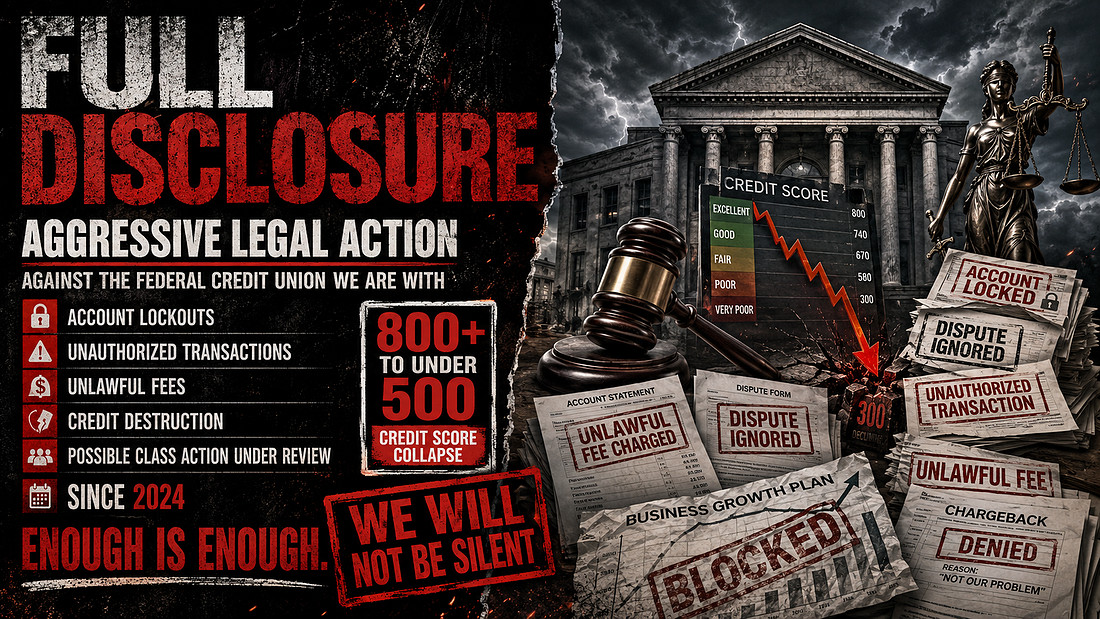 Full Disclosure: Financial Destruction in MotionFull disclosure: account lockouts, unauthorized transactions, unlawful fees, credit destruction, and business damage have forced us to take aggressive legal action, with possible class-action review now under evaluation.
There comes a point where silence is no longer an option.
Since early to mid-2024, our family and business have been dealing with what we believe is a serious and ongoing pattern of account interference, unlawful fees, unauthorized transactions, mishandled disputes, improper account restrictions, credit destruction, and financial harm caused by the federal credit union we are with.
This is not a simple customer service issue.
This is not one mistake.
This is not one late payment.
This is not one misunderstanding.
This is a financial disaster that has affected our family, our business, our credit, our ability to operate, our ability to grow, our ability to hire, our ability to obtain financing, our reputation with partners, and our ability to move forward with real business opportunities.
We are done.
We are now preparing aggressive legal action against the federal credit union we are with, and we are also evaluating whether this matter may support broader class-action review if other members were subjected to the same or similar conduct.
My Credit Was Destroyed
Before this began, I had spent my entire adult life building and protecting my credit. My credit score was over 800. I had never been late on payments. I took my obligations seriously. I paid my bills. I protected my name. I protected my family. I protected my business.
Then the federal credit union we are with locked us out, restricted access to our accounts, mishandled our disputes, refused to properly correct fees, interfered with our ability to make payments, and created a domino effect that damaged everything we had worked to build.
Because of their actions, we could not access the funds we needed. We could not make timely payments on loans held with them. We also could not make timely payments on outside obligations because they restricted access to the very money we needed to pay them.
Then the damage spread.
Payments were missed. Late fees were assessed. Accounts went into default. Other lenders began contacting us aggressively. Credit reports were damaged. And the credit score I had spent my entire adult life building collapsed from over 800 to under 500.
That is not inconvenience.
That is financial destruction.
We Tried to Repair the Relationship
What makes this even worse is that we tried to repair the relationship with the federal credit union we are with.
Even after everything that happened, we attempted to work with them. We tried to resolve the damage. We tried to move forward. We tried to give them the opportunity to correct what we believe they caused.
Instead, the same pattern continued.
We had additional unauthorized transactions hit our business account. We reported them. We disputed them. They then attempted to tell us that we only had two days to report the issue, even though we did report it and did dispute it.
Even worse, we believe they failed to properly log the dispute. That failure matters because once a dispute is made, a financial institution is supposed to follow the proper dispute, chargeback, investigation, and account-correction process.
From our position, they failed to do that.
The money in the account was there to cover the agreed payment plan amount. But because the unauthorized transaction and related dispute were not handled correctly, the account no longer had enough available funds to cover what had already been agreed to.
Then they locked down my business account again.
Our money was there.
The payment plan funds were there.
The problem was created by the unauthorized transaction, the mishandled dispute, the refusal to process the chargeback properly, and the refusal to refund fees that should not have been charged in the first place.
Enough is enough.
The Law Matters
We are now evaluating claims under federal and Florida law involving unauthorized transfers, business account protections, account access, credit reporting, consumer protection, improper collections, call harassment, unfair practices, and class-wide relief where the evidence supports it.
For consumer electronic transfers, Regulation E sets rules involving unauthorized electronic fund transfers and error-resolution procedures. For business and commercial accounts, Florida’s version of UCC Article 4A and related banking statutes may be relevant to unauthorized transactions, account duties, commercially reasonable procedures, and refund obligations.
Credit reporting is also central. Under the Fair Credit Reporting Act, furnishers of information have duties involving accurate reporting and dispute investigations, especially after receiving notice of a dispute through a consumer reporting agency.
Courts have made clear that credit-reporting investigations must be meaningful, not superficial. Cases such as Johnson v. MBNA, Boggio v. USAA Federal Savings Bank, and Saunders v. Branch Banking & Trust show that inaccurate, incomplete, or misleading credit reporting can create serious legal exposure when a furnisher fails to properly investigate or correct disputed information.
That matters here because our position is simple: if the federal credit union we are with caused or contributed to restricted account access, missed payments, mishandled disputes, improper fees, payment interference, or inability to cure the issue, then any negative reporting connected to those events must be fully examined for accuracy, completeness, and context.
Similar Cases Show This Is Serious
Major financial institutions have faced serious enforcement actions and settlements for conduct involving improper fees, inaccurate credit reporting, deposit account problems, unauthorized transactions, and consumer harm.
Other cases involving overdraft fees, junk fees, unauthorized accounts, inaccurate credit reporting, and commercial account fraud show that these are not minor issues. When financial institutions mishandle access to funds, account disputes, consumer reporting, unauthorized activity, or fee practices, the consequences can become legally serious.
We are not claiming every case is identical to ours.
We are saying the pattern matters.
When a financial institution controls access to money, restricts accounts, mishandles disputes, assesses fees, reports negative credit information, and then allows the customer or business owner to absorb the damage, the law provides remedies.
The Domino Effect Created Other Legal Action
The conduct of the federal credit union we are with did not stop with their own accounts.
Because they restricted access to our funds, we could not make payments on outside obligations. That created a domino effect with other lenders and accounts. We began receiving aggressive collection calls, repeated texts, and constant contact from other lenders.
In some instances, we were contacted all hours of the day and night. We received multiple calls and texts even after we explicitly told them to stop calling.
We have active representation regarding those matters.
We believe some of that conduct may raise issues under the Telephone Consumer Protection Act, the Telephone Sales Rule, Do Not Call protections, and Florida collection laws.
To be clear, those additional legal actions did not happen because we simply refused to pay. They happened because the federal credit union we are with created the financial domino effect that placed us in that position.
The Cease-and-Desist Error Made Things Worse
We also had representation regarding the NSF fee issues.
However, it ultimately became faster for me to push directly for the return of funds than to wait while the matter moved through the usual process.
Even then, more problems were created.
The federal credit union we are with placed a cease-and-desist designation on the wrong account. They treated the issue as though we had representation connected to our personal account, when the representation and cease-and-desist issue related to our business account.
The cease-and-desist order was placed on the business account, not the personal account.
That mistake created more damage because they refused to remove it. Even after the attorney’s firm repeatedly told them that they did not represent us in that capacity, they still refused to remove the incorrect designation.
That matters because it interfered with communication, delayed corrections, complicated disputes, and created yet another barrier to resolving the unlawful NSF fees and account issues.
This Has Blocked Our Business Growth
The damage has now gone far beyond damaged credit reports and unlawful fees.
Because of the credit destruction we believe the federal credit union we are with caused, we cannot obtain the credit and financing we need at the very moment our business has time-sensitive opportunities in front of us.
That includes our opportunity to purchase 208 pink Nanuk 935 cases, which were offered to us exclusively as part of our distributorship relationship.
This is not hypothetical damage.
This is real business interference.
We had a real inventory opportunity. We had a real supplier relationship. We had a real growth path. We had a real chance to move forward with a product line that could support NWPhotoVideo LLC’s expansion into retail, e-commerce, and distribution.
Now, because our credit has been destroyed from over 800 to under 500, we are being blocked from the very credit access and financing options needed to act on that opportunity.
This is exactly the kind of damage that cannot be measured only by looking at bank statements. It includes lost business opportunities, lost inventory access, lost revenue, lost growth, lost vendor momentum, lost strategic timing, and lost future value.
This Has Affected Every Part of Our Business
The damage does not stop with one missed payment, one disputed fee, one locked account, or one damaged credit report.
Because of what we believe the federal credit union we are with caused, we cannot obtain the credit and financing we need to move forward.
That means we cannot secure a location.
We cannot lease or purchase the warehouse space we need.
We cannot buy property.
We cannot properly store inventory.
We cannot purchase the products needed to grow our distributorship.
We cannot build the website and e-commerce platform our business needs.
We cannot actively advertise at the level required to generate revenue.
We cannot hire the people we need to operate, sell, fulfill, market, and grow.
This has affected every possible part of NWPhotoVideo LLC.
It has blocked our ability to purchase inventory.
It has blocked our ability to build our retail and distribution operation.
It has blocked our ability to get warehouse space.
It has blocked our ability to expand into property ownership.
It has blocked our ability to launch advertising campaigns.
It has blocked our ability to hire employees, contractors, and sales support.
It has blocked our ability to properly store products.
It has blocked our ability to rebuild and launch our website.
It has blocked our ability to move forward with the next phase of our company.
This is not just personal financial damage.
This is business interference.
This Has Damaged Our Reputation and Partner Momentum
With all of this comes another layer of damage that is not always visible on a bank statement: the immediate loss of trust, credibility, momentum, and professional image with the people and companies we have worked so hard to build relationships with.
When a business is preparing to grow, timing matters.
Trust matters.
Follow-through matters.
Vendor confidence matters.
Partner confidence matters.
Momentum matters.
We have spent significant time building relationships, presenting opportunities, developing partnerships, preparing for distribution, and positioning NWPhotoVideo LLC for its next phase. These were not random ideas. These were real business conversations, real vendor relationships, real growth plans, and real opportunities that required us to be ready to move.
But because of the credit destruction, account restrictions, disputed transaction failures, wrongful fees, and financial damage we believe the federal credit union we are with caused, we are now placed in the embarrassing position of having to explain delays, missed timing, financing issues, inventory limitations, and stalled growth to people we were building momentum with.
That creates immediate reputational harm.
It creates doubt where there should have been confidence.
It creates embarrassment where there should have been execution.
It creates uncertainty with partners who were expecting movement.
It creates a bad image with vendors, lenders, suppliers, contractors, potential hires, and business contacts who may not know the full story behind what happened.
A business does not grow on paper alone. It grows through trust, relationships, confidence, credibility, timing, and execution. When a financial institution destroys credit, restricts access to funds, mishandles disputes, refuses to correct fees, and blocks the ability to move forward, it damages far more than account balances.
It damages the reputation a business owner depends on to build.
This Has Also Affected Our Ability to Build the Team
This has directly affected my ability to bring on the people needed to move NWPhotoVideo LLC forward.
One of the most important pieces of our next phase is bringing on a National Sales Director — someone who would not simply be another hire, but a key partner in helping steer the ship forward.
This role is critical to building our sales pipeline, developing vendor relationships, securing sponsorships, expanding distribution, pursuing major accounts, and helping turn our momentum into real revenue.
But because of the damage we believe the federal credit union we are with caused, I cannot properly hire, onboard, compensate, or support that position the way the business requires.
A growing company cannot scale without leadership. It cannot expand without sales direction. It cannot secure major opportunities without someone helping drive relationships, follow-up, strategy, and execution.
When credit is destroyed, accounts are restricted, financing is blocked, and business funds are disrupted, it does not just affect the owner. It affects every person who could have been brought into the company to help build it.
This has affected my ability to hire staff.
It has affected my ability to bring on sales leadership.
It has affected my ability to move forward with my National Sales Director.
It has affected my ability to give that person the tools, resources, marketing support, systems, inventory, workspace, and financial backing needed to succeed.
It has affected the leadership structure we were building.
It has affected our ability to properly steer the company into its next stage.
That is another form of business damage.
This Also Involves Our Children’s Accounts
Perhaps most disturbing, this situation also involves what we believe to be improper handling of funds connected to our children’s accounts.
When a financial institution touches, takes, offsets, restricts, or interferes with accounts connected to children, the issue moves beyond inconvenience. It becomes personal. It becomes unacceptable. It becomes something that must be answered for.
We are parents before we are business owners.
And when a financial institution’s conduct reaches into accounts connected to our children, we are going to respond with the full force available under the law.
Possible Class Action Under Review
We are not only pursuing individual accountability. We are also evaluating whether this pattern may support broader class-action review.
A class action is not automatic. Class actions generally require proof that multiple people were affected by common conduct in a way that makes collective treatment appropriate.
But if discovery shows that other members of the federal credit union we are with experienced similar account lockouts, unlawful fees, mishandled disputes, improper chargeback handling, unauthorized transaction issues, incorrect account restrictions, or credit harm, then this may go beyond our family and business.
If the pattern is broader, the response must be broader.
We are evaluating that now.
What We Believe the Federal Credit Union Caused or Contributed To
We believe the federal credit union we are with caused or contributed to:
Account lockouts that prevented access to our funds;
Missed and late payments caused by restricted account access;
Defaults on loans held with them and outside obligations;
A domino effect that triggered collection activity from other lenders;
Aggressive calls and texts from other lenders after the financial damage spread;
Credit score collapse from over 800 to under 500;
NSF fees caused by their own errors, restrictions, or account handling;
Refusal to refund fees that should never have been assessed;
Unauthorized transactions on our business account;
Failure to properly log and process disputes;
Failure to follow normal chargeback procedures;
Refusal to refund disputed chargeback amounts;
Business account restrictions after funds were improperly depleted;
Damage to personal and business credit;
Interference with business operations;
Incorrect handling of cease-and-desist instructions;
Refusal to correct the cease-and-desist designation after being notified repeatedly;
Lost financing opportunities;
Lost inventory opportunities;
Lost access to warehouse and storage options;
Lost ability to purchase property;
Lost ability to build our website and e-commerce platform;
Lost advertising and marketing momentum;
Lost hiring ability;
Delayed onboarding of key leadership, including our National Sales Director;
Reputational harm with vendors, lenders, suppliers, partners, potential hires, and business contacts;
Financial hardship placed on our family;
And improper handling or taking of funds connected to our children’s accounts.
We Are Taking Aggressive Action
This is why we are taking aggressive legal action against the federal credit union we are with.
We are pursuing correction, restitution, damages, credit repair, fee reimbursement, chargeback correction, account restoration, attorney’s fees where available, consequential damages, business damages, lost opportunity damages, and every lawful remedy supported by the evidence.
We are preserving statements, screenshots, call logs, texts, credit reports, dispute records, account notices, payment records, attorney correspondence, chargeback records, NSF fee records, account restriction notices, vendor communications, financing denials, business records, and every communication showing what happened.
This is not about revenge.
This is about justice.
It is about correcting the record.
It is about restoring what was damaged.
It is about protecting our family.
It is about protecting our business.
It is about protecting our children.
It is about making sure financial institutions understand that families, business owners, and account holders are not powerless simply because the bank or credit union controls access to the account.
Since early to mid-2024, this has gone on long enough.
This cannot be allowed to keep happening to us.
And it cannot be allowed to keep happening to anyone else.
The days of asking politely and being ignored are over.
We are taking action.

